
Recent Posts
-
![Meet TYM at K 2025 -The World’ s No.1 Trade Fair for Plastics and Rubber]() Meet TYM at K 2025 -The World’ s No.1 Trade Fair for Plastics and Rubber
Meet TYM at K 2025 -The World’ s No.1 Trade Fair for Plastics and RubberWelcome to the World’s No.1 Trade Fair for Plastics and Rubber -K 2025, taking place from October 8–15, 2025 at Messe Düsseldorf, Germany. As a professional LSR injection molding machine, mold, and robot solution provider, TYM Technology Co., Ltd. is proud to present our latest innovations at Booth 16E77.
09/23/2025
-
![Vacuum-Assisted Injection for Liquid Silicone: What It Actually Fixes, and Which Products Justify the Added Cost]() Vacuum-Assisted Injection for Liquid Silicone: What It Actually Fixes, and Which Products Justify the Added Cost
Vacuum-Assisted Injection for Liquid Silicone: What It Actually Fixes, and Which Products Justify the Added CostVacuum-assisted injection reduces micro-bubbles in liquid silicone parts, but it's not worth the added cost for every product. Here's how to decide.
08/19/2026
-
![When Mold Temperature Controller and Injection Machine Fall Out of Sync: Why Parts Still Show Localized Under-Cure Even When]() When Mold Temperature Controller and Injection Machine Fall Out of Sync: Why Parts Still Show Localized Under-Cure Even When "All Parameters Are Correct"
When Mold Temperature Controller and Injection Machine Fall Out of Sync: Why Parts Still Show Localized Under-Cure Even When "All Parameters Are Correct""All parameters correct" but still getting localized under-cure? Mold temperature controller and injection machine timing mismatch is a common hidden cause.
08/18/2026
-
![How Much A/B Mixing Ratio Error Causes Under-Cure in Liquid Silicone — and How Equipment-Level Monitoring Can Catch It]() How Much A/B Mixing Ratio Error Causes Under-Cure in Liquid Silicone — and How Equipment-Level Monitoring Can Catch It
How Much A/B Mixing Ratio Error Causes Under-Cure in Liquid Silicone — and How Equipment-Level Monitoring Can Catch ItSmall A/B mixing ratio errors in liquid silicone can cause under-cured parts without visible warning. Learn the tolerance thresholds and equipment monitoring methods.
08/15/2026
-
![Injection Pressure / Servo Pressure Sensor Drift: How Often Should It Be Calibrated?]() Injection Pressure / Servo Pressure Sensor Drift: How Often Should It Be Calibrated?
Injection Pressure / Servo Pressure Sensor Drift: How Often Should It Be Calibrated?Injection pressure and servo sensor drift can silently degrade LSR part quality. Learn the warning signs and a practical calibration schedule.
08/13/2026
-
![How to Verify Whether a Supplier's]() How to Verify Whether a Supplier's "Parts Per Hour" Claim Includes Color or Mold Changeover Time
How to Verify Whether a Supplier's "Parts Per Hour" Claim Includes Color or Mold Changeover TimeWhen comparing liquid silicone rubber (LSR) injection molding machines, almost every supplier quote includes a headline number: parts per hour, or cycles per hour. It looks like the easiest number to compare — until you realize it rarely means the same thing from one supplier to the next.
08/10/2026
-
Common Failure Modes in In-Mold Assembly (IMA) on Double-Color and Double-Material LSR Machines
In-mold assembly — molding a silicone component directly onto or around a second material within a single cycle — is one of the strongest arguments for double-color and double-material LSR machines. It eliminates a secondary bonding or assembly step, reduces labor, and improves consistency versus post-mold assembly. On paper, it sounds like a straightforward efficiency gain.
08/07/2026
-
Cold Runner Clogging in LSR Injection Molding: A Practical Troubleshooting Guide
Cold runner systems are one of the main reasons manufacturers choose liquid silicone rubber (LSR) injection molding over conventional runner designs — no gate vestige, no flash to trim, and lower material waste. But when a cold runner starts to clog, that advantage disappears fast: production stops, scrap rates climb, and every hour of downtime costs real money.
08/04/2026
-
![Pure Electric Servo Feeding System vs. Traditional Pneumatic Feeding: Which One Actually Saves You Money?]() Pure Electric Servo Feeding System vs. Traditional Pneumatic Feeding: Which One Actually Saves You Money?
Pure Electric Servo Feeding System vs. Traditional Pneumatic Feeding: Which One Actually Saves You Money?If you run an LSR (Liquid Silicone Rubber) injection molding line, the feeding system is easy to overlook — until it starts costing you scrap rate, downtime, and inconsistent shot weights. Two technologies dominate the market today: pneumatic (air-driven) feeding systems and pure electric servo feeding systems. Here's an honest, practical comparison to help you decide which fits your production line.
07/31/2026
-
![How to Choose an LSR OEM Manufacturing Partner: A Buyer's Checklist]() How to Choose an LSR OEM Manufacturing Partner: A Buyer's Checklist
How to Choose an LSR OEM Manufacturing Partner: A Buyer's ChecklistOutsourcing liquid silicone rubber production is as much a relationship decision as a technical one. A supplier can look strong on paper — certificates, equipment lists, a polished website — and still fall short once your product hits real production volume. Here's a practical checklist for evaluating an LSR OEM partner before you commit tooling and inventory to them.
07/29/2026





Liquid Silicone Rubber Market 2026: Size, Growth & Demand Drivers
The global liquid silicone rubber (LSR) market is worth roughly USD 3.4-3.8 billion in 2026, expanding at an estimated 7-9% CAGR. Growth is driven mainly by medical devices and electric-vehicle components. This briefing summarizes the latest market size, leading segments, and demand drivers for B2B buyers, product engineers, and procurement teams.
How big is the liquid silicone rubber market in 2026?
LSR market estimates for 2026 range from about USD 2.5 billion to USD 3.8 billion, with a consensus mid-point near USD 3.4 billion and a CAGR of 7-9%. The spread reflects different scopes and methodologies across research firms, but every major source agrees the market is growing faster than most commodity elastomers.
Research source | 2026 market size | Reported CAGR |
MarketsandMarkets | ~USD 3.82 billion (by 2026) | 8.3% |
Persistence Market Research | ~USD 3.6 billion | 8.7% (2026-2033) |
Business Research Insights | ~USD 2.46 billion | 6.2% (to 2034) |
Consensus working range | USD 3.4-3.8 billion | ~7-9% |
Which segments lead LSR demand?
Medical-grade LSR leads the market, accounting for roughly 44% of grade-segment revenue in 2026. Medical-grade material typically sells at 2-3 times the price of industrial grades because of higher raw-material purity, biological testing, documentation, and supply-chain traceability. Other major segments include automotive, electrical and electronics, and consumer and baby-care products.
• Medical: catheters, respiratory mask seals, syringe plungers, hearing-aid parts, wearable biosensor interfaces.
• Automotive & EV: battery and connector seals, gaskets, thermal interface parts, ignition components.
• Electronics: waterproof seals, keypads, and protective overmolding for consumer devices.
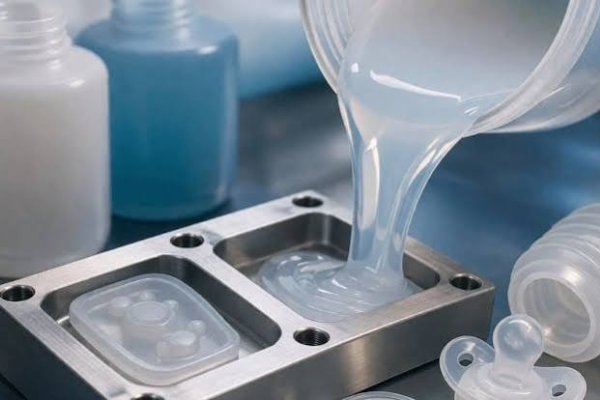
• Baby & consumer: pacifiers, bottle nipples, kitchenware, and wearable straps.
Why is medical-grade LSR growing fastest?
Medical-grade LSR grows fastest because regulators require certified biocompatible materials for any polymer in patient contact. Materials must meet ISO 10993, USP Class VI, and FDA requirements that confirm they are non-toxic, non-cytotoxic, and safe for prolonged human contact. Rising surgical volumes, home-care devices, and wearable monitoring all expand demand for compliant LSR.
How are EVs and electronics reshaping demand?
Electric-vehicle production is now a primary growth engine for LSR. EVs need sealing and insulation that survive heat, vibration, and moisture—roles where LSR outperforms thermoplastics and conventional rubber. In electronics, the shift to waterproof, miniaturized devices increases use of precision LSR overmolding and micro-molding.
Which regions drive the market?
Asia-Pacific leads both LSR consumption and manufacturing capacity, with China the central production hub. Strong electronics, automotive, and medical manufacturing bases, plus competitive equipment and tooling supply, keep the region ahead of North America and Europe in volume growth. This concentration also makes Asia-Pacific the most cost-effective place to source LSR machines and molds.
What it means for buyers in 2026
For procurement teams and product engineers, a growing, medical-led market means more material choice and stronger supplier ecosystems—but also tighter compliance expectations. Buyers planning new silicone programs should lock in material certifications early, design for efficient molding, and choose equipment partners that can scale from prototype to validated mass production.
FAQs
Q:What is the LSR market size in 2026?
Estimates place the global liquid silicone rubber market at roughly USD 3.4-3.8 billion in 2026, with some narrower-scope reports as low as USD 2.5 billion. The differences come from how each firm defines product grades and end-use applications, so a range is more reliable than a single figure.
Q:What is the LSR market growth rate (CAGR)?
Most forecasts put LSR market growth at about 7-9% CAGR through the early 2030s. This outpaces many commodity elastomers and is sustained by medical devices, electric vehicles, and waterproof electronics rather than by any single industry.
Q:Which industry uses the most LSR?
Medical is the largest grade segment, at roughly 44% of revenue in 2026, because patient-contact devices require biocompatible, certified silicone. Automotive, electronics, and baby-care products make up most of the remaining demand.
Q:Why is medical-grade LSR more expensive?
Medical-grade LSR usually costs 2-3 times more than industrial grades. The premium covers higher raw-material purity, ISO 10993 and USP Class VI biological testing, full documentation, and strict supply-chain traceability needed for regulatory approval.