
Recent Posts
-
![Meet TYM at K 2025 -The World’ s No.1 Trade Fair for Plastics and Rubber]() Meet TYM at K 2025 -The World’ s No.1 Trade Fair for Plastics and Rubber
Meet TYM at K 2025 -The World’ s No.1 Trade Fair for Plastics and RubberWelcome to the World’s No.1 Trade Fair for Plastics and Rubber -K 2025, taking place from October 8–15, 2025 at Messe Düsseldorf, Germany. As a professional LSR injection molding machine, mold, and robot solution provider, TYM Technology Co., Ltd. is proud to present our latest innovations at Booth 16E77.
09/23/2025
-
![ISO 9001, CE, CCC: What These Certifications Actually Mean for Your Equipment Purchase]() ISO 9001, CE, CCC: What These Certifications Actually Mean for Your Equipment Purchase
ISO 9001, CE, CCC: What These Certifications Actually Mean for Your Equipment PurchaseWhen you're evaluating LSR injection molding machines from an overseas supplier, certification logos on a company website can start to blur together. ISO 9001, CE, CCC — they all sound reassuring, but they don't all mean the same thing, and they don't all matter for the same reasons. Understanding what each certification actually covers will help you ask better questions during due diligence and avoid assuming a certificate guarantees something it doesn't.
07/17/2026
-
![Turnkey LSR Injection Molding Solutions]() Turnkey LSR Injection Molding Solutions
Turnkey LSR Injection Molding SolutionsLaunching a liquid silicone rubber (LSR) injection molding operation involves far more than simply purchasing a machine. From material selection and mold design to automation integration and staff training, the journey from concept to full-scale production presents numerous challenges—each with the potential to delay your time-to-market and inflate your budget.
07/14/2026
-
![Industrial Silicone Seals & Waterproof Parts: LSR Guide]() Industrial Silicone Seals & Waterproof Parts: LSR Guide
Industrial Silicone Seals & Waterproof Parts: LSR GuideThis guide helps product and sourcing engineers who need reliable industrial sealing components-gaskets, O-rings, grommets, and enclosure seals-understand why LSR injection molding is the preferred process for waterproof parts at volume, and how to specify them.
07/10/2026
-
![LSR Prototype to Production: Timeline & Process]() LSR Prototype to Production: Timeline & Process
LSR Prototype to Production: Timeline & ProcessA typical liquid silicone rubber (LSR) part moves from prototype to mass production in about 10-18 weeks, spanning design/DFM, prototyping, production mold fabrication, T1 sampling and validation, and pilot-to-ramp - with mold build and validation being the longest stages.
07/07/2026
-
![LSR Injection Molding Machine Parameters Explained]() LSR Injection Molding Machine Parameters Explained
LSR Injection Molding Machine Parameters ExplainedAn LSR injection molding machine spec sheet lists dozens of numbers, but only a handful decide whether your silicone parts cure fully, stay flash-free and cost little to run. This 2026 guide explains the parameters that matter most, so engineers and buyers can compare machines on the specs that actually affect part quality, not marketing figures.
07/02/2026
-
![Automatic vs Semi-Automatic Silicone Molding Lines]() Automatic vs Semi-Automatic Silicone Molding Lines
Automatic vs Semi-Automatic Silicone Molding LinesThis guide is for production and procurement decision-makers sizing a new LSR line—comparing the two configurations across throughput, quality, cost, and payback so you can match the investment to real demand.
07/01/2026
-
![LSR Cold Runner Systems: Cut Waste & Cost]() LSR Cold Runner Systems: Cut Waste & Cost
LSR Cold Runner Systems: Cut Waste & CostLSR cold runner system is the single fastest way to cut material waste and labor out of liquid silicone rubber molding. By keeping the silicone liquid until it reaches the cavity, it eliminates cured runners and trimming entirely. This guide helps process engineers and buyers decide when a cold runner pays for itself.
06/30/2026
-
![How to Select LSR Injection Molding Machine Tonnage]() How to Select LSR Injection Molding Machine Tonnage
How to Select LSR Injection Molding Machine TonnageChoosing the right clamping force is the single most consequential spec decision when buying a liquid silicone rubber (LSR) injection molding machine. Pick too little and you fight flash on every shot; pick too much and you pay for energy and floor space you never use.
06/29/2026
-
![Liquid Silicone Rubber Market 2026: Size, Growth & Demand Drivers]() Liquid Silicone Rubber Market 2026: Size, Growth & Demand Drivers
Liquid Silicone Rubber Market 2026: Size, Growth & Demand DriversThe global liquid silicone rubber (LSR) market is valued at roughly USD 3.4-3.8 billion in 2026 and growing about 7-9% annually, led by medical-grade demand (~44% of revenue) and rising EV production. Asia-Pacific dominates manufacturing capacity.
06/26/2026





Discover the Top Suppliers for Medical-Grade Silicone Respirator Molds and Injection Machines
The global demand for high-precision medical components, especially silicone respirators and masks, has created a critical need for reliable manufacturing equipment. Selecting the right injection molding machine and mold supplier is not just a procurement decision; it's a foundational step for product safety, regulatory compliance, and long-term business viability. Based on our extensive experience at TYM (Tianyuan Intelligent Manufacturing Technology Co., Ltd.) in serving the medical sector, here’s a data-backed, practical guide to help you avoid common pitfalls.
1. Prioritize Medical-Grade Compliance and Traceability
The "medical-grade" label is non-negotiable. It encompasses the material, the manufacturing process, and the final product's performance.
The Pitfall: Assuming any LSRI (Liquid Silicone Rubber Injection) machine can produce medical parts. Machines not designed for this sector may introduce contaminants, have inconsistent shot control, or lack the necessary documentation for audits.
The Data Point: Regulatory bodies like the FDA and CE require stringent process validation. A 2022 industry survey indicated that over 30% of audit non-conformances for new medical device manufacturers were linked to inadequate equipment qualification and process control documentation.
Our View & TYM's Approach: Compliance starts with the machine design. Our LSRI machines for medical applications are built with polished, crevice-free surfaces to prevent bacterial harborage and are compatible with cleanroom environments. We provide full material traceability for critical components and detailed machine validation protocols (IQ/OQ) support, which are essential for your regulatory submissions.
Your Actionable Step: Before requesting quotes, prepare a User Requirements Specification (URS) document. Mandate that potential suppliers provide evidence of: Machine surface finish specifications (e.g., Ra ≤ 0.8µm).
Material certificates for fluid-contact parts.
A history of machines used in certified medical production facilities.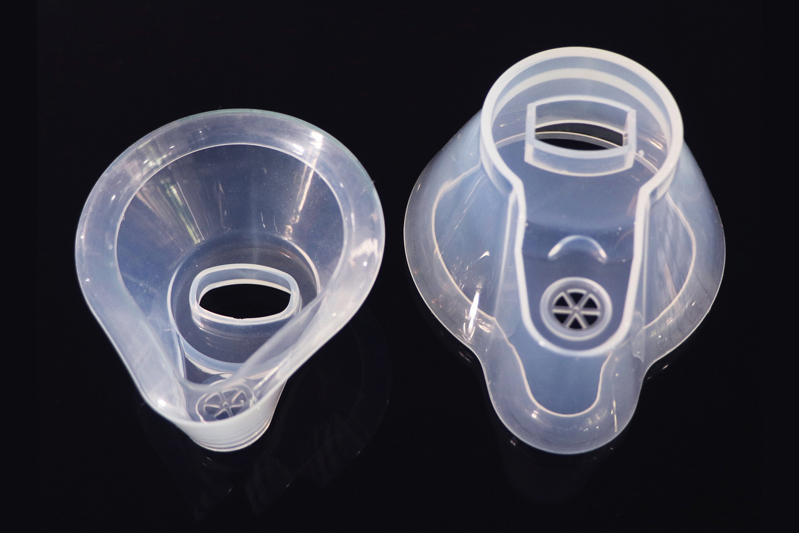
2. Demand Precision and Repeatability Over Raw Power
For silicone respirator components like valves, seals, or mask frames, dimensional accuracy and consistency are paramount. A deviation of a few microns can cause leakage or failure.
The Pitfall: Focusing solely on clamp tonnage or shot size. A powerful but imprecise machine will produce waste and unreliable products.
The Case Study: A European manufacturer switched from a standard machine to a high-precision model for a silicone ventilator valve. This reduced their rejection rate from 5.2% to 0.8%, saving an estimated €150,000 annually in material and rework costs.
Our View & TYM's Solution: Precision is engineered into the system. We utilize a high-rigidity lock-mold structure that minimizes deflection under high pressure, directly contributing to extended mold life and superior part consistency. Our optimized hydraulic system achieves injection speeds up to 100g/s, ensuring fast, uniform cavity filling which is critical for thin-walled respirator parts. This speed, combined with stability, is what matters.
Your Actionable Step: Ask suppliers for Cp/Cpk data from repeatability tests on a standard part. Visit their facility and witness a capability study run. For molds, require a First Article Inspection (FAI) report as a standard deliverable.
3. Evaluate the Ecosystem, Not Just the Machine
A medical-grade silicone respirator is the result of a synchronized system: the injection machine, the mold, the material handling (mixer, pump), and the control software.
The Pitfall: Sourcing the machine, mold, and auxiliaries from different vendors. When issues arise, vendors often blame each other, leaving you with costly downtime and unresolved problems.
The Reality: Seamless integration between the colorant pump, the LSR mixer, and the injection unit is crucial for color consistency and eliminating air bubbles in clear or skin-contact parts.
Our Integrated Offering: At TYIM, we provide a complete LSR equipment solution. This includes the core injection machine, custom-designed molds, intelligent feeding systems, and precision color paste pumps. We ensure all components communicate flawlessly. Furthermore, to guarantee reliability, our machines are equipped with key components from renowned European and Japanese manufacturers.
Your Actionable Step: Shortlist suppliers who can demonstrate responsibility for the entire cell. Ask for a single-point-of-contact service agreement and a unified software interface that controls the entire production process.
4. Insist on Customization and Future-Proofing
Your product is unique. A standard, off-the-shelf machine might force you to compromise on your design or production efficiency.
The Pitfall: Selecting a supplier with a rigid, catalog-only approach. This can limit innovation and make scaling production difficult.
Industry Trend: The move towards multi-material and overmolding (e.g., combining soft silicone seals with rigid plastic frames) is growing. A 2023 report showed a 25% year-on-year increase in inquiries for such machines in the medical sector.
Our Capability: We specialize in tailored design. Whether you need a micro-precision machine for tiny valve components, a dual-material LSR injection machine for complex assemblies, or a fully automated cell with robotics, we engineer to your specific Actual Demand. Our specialized high-speed screws offer superior plasticizing ability for different LSR grades.
Your Actionable Step: Present your current and future product roadmap to potential suppliers. Assess their engineering team's willingness and ability to develop custom solutions. Ask for case studies where they have solved unique challenges similar to yours.
A Final Thought from Our Workshop
Choosing equipment for medical silicone production is a partnership, not just a purchase. The right partner understands that your success is their success. They will invest time in understanding your challenges, be transparent about capabilities, and stand behind their system with unwavering support.
While several established manufacturers like ENGEL, ARBURG, and DESMA offer excellent machines globally, the decision often comes down to who provides the most cohesive, responsive, and customized solution for your specific application in the demanding medical field.
At TYIM, we build more than machines; we build reliable production foundations. Our goal is to empower you to manufacture life-critical components with confidence, precision, and efficiency, turning complex regulations and high standards into your competitive advantage.