
Recent Posts
-
![Meet TYM at K 2025 -The World’ s No.1 Trade Fair for Plastics and Rubber]() Meet TYM at K 2025 -The World’ s No.1 Trade Fair for Plastics and Rubber
Meet TYM at K 2025 -The World’ s No.1 Trade Fair for Plastics and RubberWelcome to the World’s No.1 Trade Fair for Plastics and Rubber -K 2025, taking place from October 8–15, 2025 at Messe Düsseldorf, Germany. As a professional LSR injection molding machine, mold, and robot solution provider, TYM Technology Co., Ltd. is proud to present our latest innovations at Booth 16E77.
09/23/2025
-
![Industrial Silicone Seals & Waterproof Parts: LSR Guide]() Industrial Silicone Seals & Waterproof Parts: LSR Guide
Industrial Silicone Seals & Waterproof Parts: LSR GuideThis guide helps product and sourcing engineers who need reliable industrial sealing components-gaskets, O-rings, grommets, and enclosure seals-understand why LSR injection molding is the preferred process for waterproof parts at volume, and how to specify them.
07/10/2026
-
![LSR Prototype to Production: Timeline & Process]() LSR Prototype to Production: Timeline & Process
LSR Prototype to Production: Timeline & ProcessA typical liquid silicone rubber (LSR) part moves from prototype to mass production in about 10-18 weeks, spanning design/DFM, prototyping, production mold fabrication, T1 sampling and validation, and pilot-to-ramp - with mold build and validation being the longest stages.
07/07/2026
-
![LSR Injection Molding Machine Parameters Explained]() LSR Injection Molding Machine Parameters Explained
LSR Injection Molding Machine Parameters ExplainedAn LSR injection molding machine spec sheet lists dozens of numbers, but only a handful decide whether your silicone parts cure fully, stay flash-free and cost little to run. This 2026 guide explains the parameters that matter most, so engineers and buyers can compare machines on the specs that actually affect part quality, not marketing figures.
07/02/2026
-
![Automatic vs Semi-Automatic Silicone Molding Lines]() Automatic vs Semi-Automatic Silicone Molding Lines
Automatic vs Semi-Automatic Silicone Molding LinesThis guide is for production and procurement decision-makers sizing a new LSR line—comparing the two configurations across throughput, quality, cost, and payback so you can match the investment to real demand.
07/01/2026
-
![LSR Cold Runner Systems: Cut Waste & Cost]() LSR Cold Runner Systems: Cut Waste & Cost
LSR Cold Runner Systems: Cut Waste & CostLSR cold runner system is the single fastest way to cut material waste and labor out of liquid silicone rubber molding. By keeping the silicone liquid until it reaches the cavity, it eliminates cured runners and trimming entirely. This guide helps process engineers and buyers decide when a cold runner pays for itself.
06/30/2026
-
![How to Select LSR Injection Molding Machine Tonnage]() How to Select LSR Injection Molding Machine Tonnage
How to Select LSR Injection Molding Machine TonnageChoosing the right clamping force is the single most consequential spec decision when buying a liquid silicone rubber (LSR) injection molding machine. Pick too little and you fight flash on every shot; pick too much and you pay for energy and floor space you never use.
06/29/2026
-
![Liquid Silicone Rubber Market 2026: Size, Growth & Demand Drivers]() Liquid Silicone Rubber Market 2026: Size, Growth & Demand Drivers
Liquid Silicone Rubber Market 2026: Size, Growth & Demand DriversThe global liquid silicone rubber (LSR) market is valued at roughly USD 3.4-3.8 billion in 2026 and growing about 7-9% annually, led by medical-grade demand (~44% of revenue) and rising EV production. Asia-Pacific dominates manufacturing capacity.
06/26/2026
-
![Self-Bonding LSR: How Self-Adhesive Liquid Silicone Simplifies Multi-Material Overmolding]() Self-Bonding LSR: How Self-Adhesive Liquid Silicone Simplifies Multi-Material Overmolding
Self-Bonding LSR: How Self-Adhesive Liquid Silicone Simplifies Multi-Material OvermoldingIf you manufacture multi-material silicone parts, the bonding step is often the hidden bottleneck. Traditional liquid silicone rubber (LSR) overmolding relies on a separately applied primer to make the silicone stick to a plastic or metal substrate.
06/18/2026
-
![Smart Automation in Silicone Manufacturing: Improving Consistency and Reducing Labor Costs]() Smart Automation in Silicone Manufacturing: Improving Consistency and Reducing Labor Costs
Smart Automation in Silicone Manufacturing: Improving Consistency and Reducing Labor CostsLabor shortages, rising wage costs, and increasing quality expectations are pushing silicone product manufacturers toward greater automation. For liquid silicone rubber (LSR) production specifically, automation is not just about reducing headcount — it directly impacts part consistency, contamination control, and overall production efficiency.
06/12/2026




Industrial Silicone Seals & Waterproof Parts: LSR Guide
Why Use LSR for Industrial Silicone Seals?
LSR injection molding is the preferred process for high-volume industrial seals because it combines precise, flash-free geometry with silicone's wide temperature and weather resistance. Liquid silicone rubber holds elasticity from roughly -50 C to +200 C, resists UV, ozone, and water, and can be molded to tight tolerances at cycle times often under 60 seconds-so a single automated line can produce millions of consistent sealing parts a year.
LSR vs Other Sealing Materials
Property | LSR Silicone | EPDM | NBR (Nitrile) |
Temp range | -50 to +200 C | -40 to +130 C | -30 to +120 C |
UV / ozone / weather | Excellent | Very good | Poor |
Compression set | Low (excellent) | Good | Moderate |
Oil / fuel resistance | Moderate | Poor | Excellent |
High-volume precision | Excellent (LSR IM) | Moderate | Moderate |
Comparison sentence: Choose LSR for weatherproof, high-temp, high-volume seals; choose NBR only where oil and fuel contact dominates and UV exposure is low.
What Does IP67 vs IP68 Mean for Sealed Parts?
IP ratings define how well an enclosure resists dust and water, and the seal is what delivers them. IP67 means dust-tight and protected against temporary immersion (1 m, 30 min); IP68 means protection against continuous immersion under conditions set by the maker (often deeper/longer). A correctly designed LSR gasket with the right compression and groove geometry is what turns a plastic enclosure into an IP67- or IP68-rated product.
IP Rating | Dust | Water Protection |
IP65 | Dust-tight | Low-pressure water jets |
IP67 | Dust-tight | Temporary immersion, 1 m / 30 min |
IP68 | Dust-tight | Continuous immersion (maker-defined depth) |
IP69K | Dust-tight | High-pressure, high-temp wash-down |
How Should You Design a Silicone Sealing Part?
Good seal design controls compression, not just shape. Most static silicone seals work best at 15-30% compression; too little leaks, too much causes set and tearing. Key design rules for LSR seals:
· Target 15-30% compression for static seals; keep it consistent around the perimeter.
· Design an enclosed or shouldered groove so the seal cannot roll or extrude out.
· Use uniform cross-sections (avoid thick/thin transitions) to prevent voids and sinks.
· Choose durometer to match: 30-50 Shore A for soft conformable seals, 60-70 Shore A for structural gaskets.
· Add draft and specify demolding-friendly finish on thin sealing lips.
Which Industrial Parts Are Made This Way?
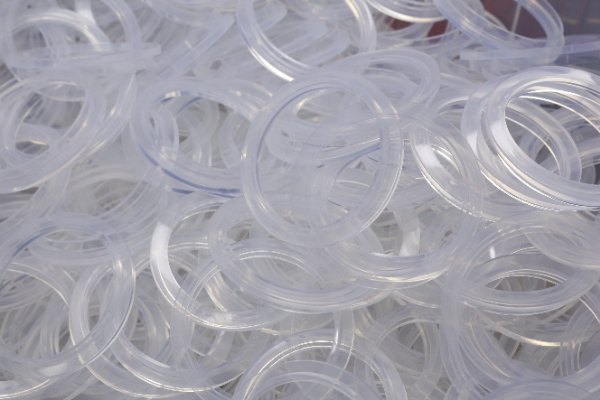
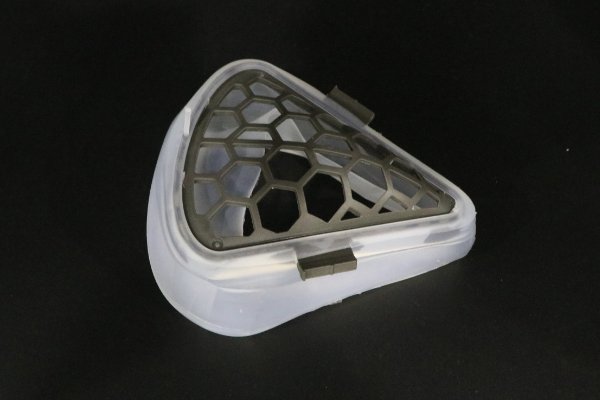
LSR molding covers most elastomeric sealing and protection components used in electronics, outdoor equipment, and machinery.
Part Type | Typical Function | Common Sectors |
Enclosure gaskets | Seal housings to IP67/IP68 | Electronics, lighting, EV, telecom |
O-rings / X-rings | Static & dynamic sealing | Fluid systems, pumps, valves |
Grommets / cable seals | Seal cable entries | Outdoor equipment, automotive |
Membranes / vents | Pressure equalization, waterproof venting | Sensors, lighting, wearables |
Bumpers / bushings | Vibration & shock damping | Machinery, appliances |
How Are Industrial Silicone Seals Tested?
Seals are validated against both material and functional standards. Material properties follow ASTM D2000 / ISO 37, while finished waterproof products are checked to IEC 60529 (IP code). Common tests include compression set (ISO 815), tensile and elongation (ISO 37), and leak or immersion testing to the target IP rating. For volume production, a smart line adds inline vision and dimensional checks so every part is verified, not just samples.
FAQs
Q: Is LSR or HCR silicone better for industrial seals?
A: For high-volume, precision seals, LSR injection molding wins: it automates well, gives flash-free tolerances, and runs fast cycles. HCR (high-consistency rubber) can suit very large cross-sections, extruded profiles, or low-volume custom seals. For most enclosure gaskets, O-rings, and grommets made in the thousands or millions, LSR is the more economical and consistent choice.
Q: What compression gives a reliable waterproof seal?
A: Most static silicone seals seal reliably at 15-30% compression. Below about 10% the seal may leak under tolerance stack-up or thermal movement; above 30% you risk permanent compression set, tearing, or extrusion. The groove and mating parts should be designed so the seal stays within that band across all tolerances and operating temperatures.
Q: Can LSR seals reach IP68?
A: Yes. IP68 is achieved through seal design, not material alone. An LSR gasket with the correct durometer (often 40-60 Shore A), an enclosed groove, and 15-30% compression can deliver continuous-immersion IP68 sealing. The rating must be validated by immersion testing to the depth and duration the manufacturer specifies, since IP68 conditions are defined per product.
Q: What temperature range do silicone seals handle?
A: Standard LSR seals stay elastic and functional from about -50 C to +200 C, with specialty grades extending higher for short exposures. This wide range, plus strong UV, ozone, and weather resistance, is why silicone is preferred for outdoor, automotive, and lighting seals over materials like NBR that harden or crack in cold or sunlight.